pipe - standardized parametric pipes
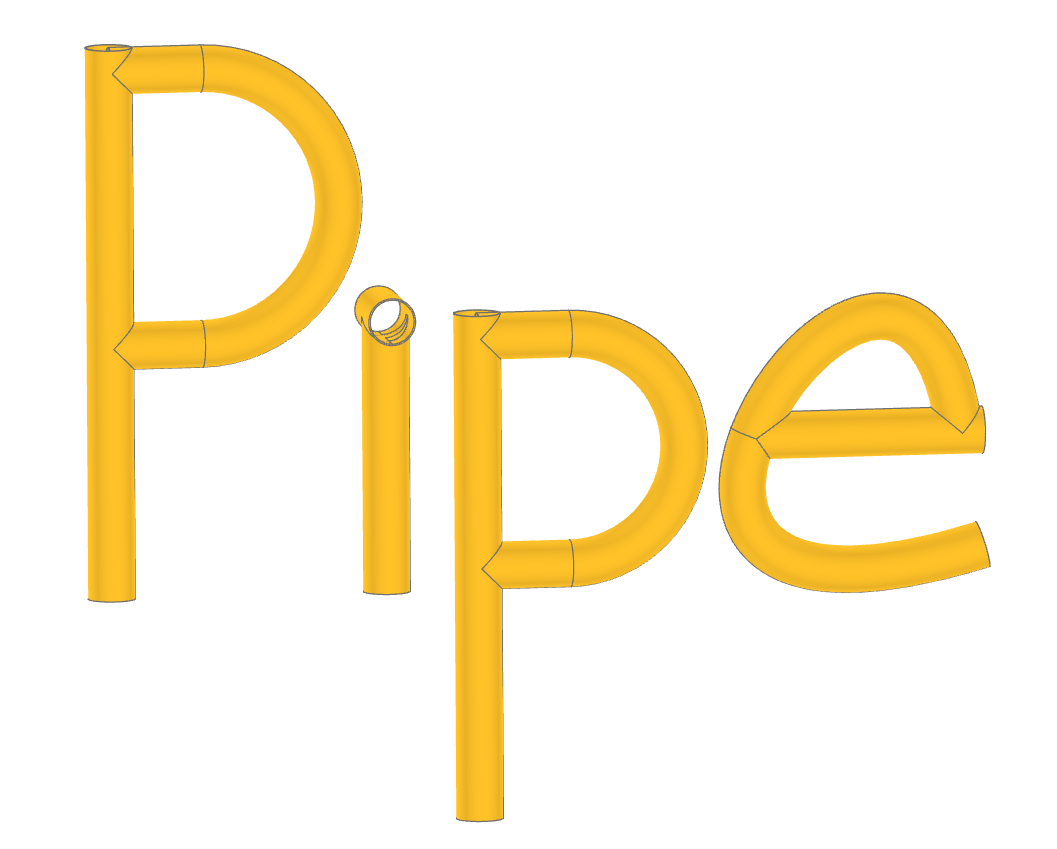
Pipes are a critical component of many industrial and chemical processing facilities. The pipe sub-package provides Pipe and PipeSection classes that make the creation of industry standard sized pipes easy by providing an API that just requires selection from commonly used parameters.
from build123d import *
from bd_warehouse.pipe import Pipe

stainless_pipe = Pipe(
    nps="2 1/2",
    material="stainless",
    identifier="10S",
    path=Edge.make_line((0, 0, 0), (5 * FT, 0, 0)),
)

with BuildPart() as copper_pipes:
    with BuildLine(Plane.XZ):
        l1 = Line((0, 0), (0, 6 * FT))
        l2 = Line(l1 @ 1 + (0, -3 * IN), l1 @ 1 + (1 * FT, -3 * IN))
        l3 = RadiusArc(l2 @ 1, l2 @ 1 + (0, -3 * FT), 1.5 * FT)
        l4 = Line(l3 @ 1, l3 @ 1 + (-1 * FT, 0))
    Pipe(nps="6", material="copper", identifier="K")
There are three parameters that required to define a pipe: nps, material, and identifier.
nps
NPS stands for “Nominal Pipe Size.” It is a standard designation used to indicate the approximate inside diameter (ID) of a pipe or fitting, typically for industrial and plumbing applications. NPS is expressed as a numerical value without any unit of measurement.
It’s important to note that NPS does not directly correspond to the actual physical dimensions of the pipe. Instead, it provides a convenient reference for pipe sizing and selection purposes. The actual outside diameter (OD) and wall thickness of a pipe can vary depending on the specific material, manufacturing standards, and application requirements.
NPS values are based on a standardized system and are associated with a specific set of dimensions and tolerances provided by various standards, such as ASME B36.10 for carbon and alloy steel pipes and ASME B36.19 for stainless steel pipes.
When specifying or discussing pipe sizes, NPS is commonly used to identify the general size range of a pipe, and further details such as OD and wall thickness are provided separately. It serves as a convenient way to communicate and compare pipe sizes within the industry, facilitating the selection and compatibility of pipes, fittings, and related components.
- Nps
alias of
Literal[‘1/8’, ‘1/4’, ‘3/8’, ‘1/2’, ‘3/4’, ‘1’, ‘1 1/4’, ‘1 1/2’, ‘2’, ‘2 1/2’, ‘3’, ‘4’, ‘5’, ‘6’, ‘8’, ‘10’, ‘12’, ‘14’, ‘16’, ‘18’, ‘20’, ‘22’, ‘24’, ‘30’, ‘32’, ‘34’, ‘36’, ‘42’]
material & identifier
The dimensions of pipes vary by the pipe material as described in the following Specifications section.
The following table defines the available materials and the valid identifier’s for each material:
material |
description |
identifier or schedule |
|---|---|---|
“abs” |
drainage or vent pipes |
“40” |
“copper” |
plumbing pipes |
“K”, “L”, “M” |
“iron” |
iron/steel pipes |
“STD”, “XS”, “XXS” |
“pvc” |
water pipes |
“40”, “80” |
“stainless” |
austenitic stainless steel pipe |
“5S”, “10S”, “20S”, “40S”, “80S” |
“steel” |
steel pipes |
“10”, “20”, “30”, “40”, “60”, “80”, “100”, “120”, “140”, “160” |
Joints
All pipes are created with two RigidJoint: inlet and outlet. These joints
are positioned in the center of the pipe and oriented such that connecting the outlet
of one pipe to the inlet of another will align them appropriately.
Specifications
The pipes created by this package are based off the following standards:
ASTM A312 is a standard specification issued by the American Society for Testing and Materials (ASTM) that covers seamless, welded, and heavily cold-worked austenitic stainless steel pipe intended for high-temperature and general corrosive service. The standard specifies various dimensions, mechanical properties, testing requirements, and acceptable manufacturing practices for stainless steel pipes.
ASME B36 is a standard issued by the American Society of Mechanical Engineers (ASME) that provides guidelines for the dimensions, tolerances, and related requirements of steel pipes and fittings. It covers both seamless and welded pipes made from various materials, including carbon steel, stainless steel, and alloy steel. The standard specifies the nominal pipe sizes (NPS), outside diameters (OD), wall thicknesses, and length dimensions. ASME B36 aims to ensure consistency and compatibility in the design, manufacturing, and installation of steel pipes, facilitating efficient piping system construction and operation in various industries.
ASTM B88 is a standard specification issued by ASTM International for seamless copper water tube used in plumbing applications. The standard defines the requirements for copper water tube in terms of its dimensions, chemical composition, mechanical properties, and permissible variations. It covers various sizes and types of copper water tube, including both hard-drawn and annealed tempers. ASTM B88 ensures the quality and reliability of copper water tube by providing specifications for its manufacturing and performance. It serves as a reference for manufacturers, engineers, and contractors involved in plumbing systems, ensuring compatibility, durability, and safe water transportation.
ASTM F628 is a standard specification issued by ASTM International that pertains to the installation and performance requirements of plastic pipes in non-pressure applications. It specifically focuses on the installation of plastic pipes, such as PVC (Polyvinyl Chloride) and CPVC (Chlorinated Polyvinyl Chloride), for drainage, waste, and vent systems. The standard covers various aspects, including pipe sizes, materials, dimensions, joint methods, and testing procedures. ASTM F628 ensures the proper installation and performance of plastic pipes in non-pressure plumbing applications, promoting safe and efficient drainage and waste disposal systems in residential and commercial buildings.
ASTM D1785 is a standard specification issued by ASTM International for rigid polyvinyl chloride (PVC) pipes used in pressure applications, primarily in potable water systems. The standard outlines the requirements for PVC pipes in terms of their dimensions, material properties, and quality control procedures. It covers various aspects, including pipe sizes, wall thicknesses, chemical composition, hydrostatic pressure testing, and marking. ASTM D1785 ensures the durability, strength, and safety of PVC pipes by establishing guidelines for their manufacturing, performance, and testing. The standard serves as a reference for manufacturers, engineers, and regulatory bodies to ensure the reliable and efficient use of PVC pipes in pressure applications.